Thanos Paraschos
Thanos Paraschos
Directeur du centre médical EmBIO IVF Athènes, Grèce
Consultant obstétricien - Gynécologue à l'Hôpital IASO
FIV - Chirurgie Laparoscopique Avancée
Chef de la Clinique / Chargé de Recherche
Hôpital de Hammersmith
Université Imperial
Londres, Royaume-Uni
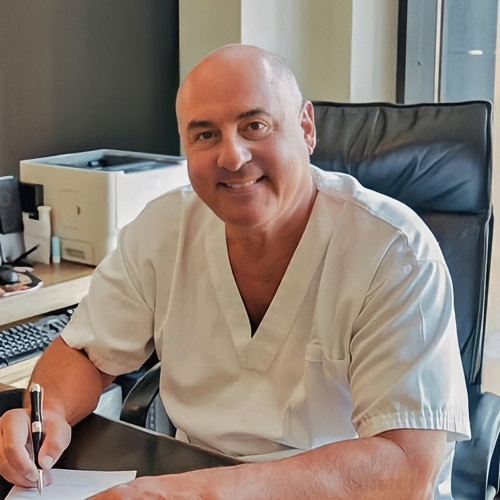
Le Dr Thanos Paraschos est un obstétricien et gynécologue de renommée internationale, spécialisé dans les traitements de l'infertilité.
Il a pris part à l'équipe (T. Paraschos, J. Soussis, J.C. Harper, E. Kontogianni, D. Packham, A.H. Handyside) qui a réalisé le premier diagnostic génétique préimplantatoire au monde à l'hôpital Hammersmith, aux côtés du Professeur Robert Winston.
La clinique de fertilité Wolfson de l'hôpital Hammersmith a été la première à accueillir un bébé né par FIV à Londres. Certains des plus grands spécialistes du traitement de la fertilité ont fait partie de l'équipe de l'hôpital Hammersmith au fil des ans, notamment le Professeur Robert Winston, spécialisé dans le programme de préservation de la fertilité et de congélation des ovocytes.
En collaboration avec l'équipe du Professeur Robert Winston, Thanos Paraschos a inventé le Cathéter Wallace Rigide, utilisé depuis lors par des milliers de scientifiques dans le monde entier pour des transferts d'embryons particulièrement exigeants.
Sa participation approfondie à la recherche médicale sur la fertilité et les technologies de reproduction assistée comprend d'importantes publications médicales parues dans des revues médicales évaluées par des pairs. L'impact des recherches du Dr Paraschos sur la communauté scientifique se manifeste par le grand nombre de citations de ses études par des milliers de spécialistes de la reproduction humaine et de la génétique.
Il est le directeur médical et le fondateur d'EmBIO IVF.
Il est aujourd'hui membre des sociétés de fertilité suivantes :
- Société Britannique de Fertilité
- Société Américaine de Médecine Reproductive - ASRM
- ESHRE
- Société Hellénique de Fertilité et de Stérilité (HSFS)
Consultation En Ligne Gratuite avec le Dr Thanos Paraschos et son équipe
En lire plus :
- Formation en Médecine
- Spécialiste de la Fertilité
- > Formé auprès du Lord Professeur Robert Winston
- > Monsieur R. Edwards (le Pionnier de la FIV) et Thanos Paraschos
- Obstétricien
- > Collaboration avec le Professeur Kypros Nicolaides
- Gynécologue
- Publications in Reer-Reviewed Journals (in english)
- Presentations in Infertility & Reproduction (in english)
Formation en Médecine
Mars 1995 - Mars 1996
CHEF DE CLINIQUE PRINCIPAL/CHARGÉ DE RECHERCHE
avec Linsday Mc Millan
Hôpital de Whipps Cross, Londres
Département de Gynécologie
> Chirurgie laparoscopique avancée
Mar 1993 - Mar 1995
CHEF DE CLINIQUE PRINCIPAL/CHARGÉ DE RECHERCHE
avec le Lord Professeur Robert Winston
Hôpital de Hammersmith
Université d'Imperial, Londres
Institut d'Obstétrique et de Gynécologie
Royal Postgraduate Medical School
> Études sur l'Infertilité et la Fécondation in vitro
image de robert winston
Mar 1992 - Mar 1993
CHEF DE CLINIQUE
avec D N Joyce, Philip Smith, Miss G Turner
Hôpital de Southmead, Bristol, Angleterre
> Obstétrique et Gynécologie
Nov 1991 - Fév 1992
HAUT DIRIGEANT DE L’ÉTABLISSEMENT
avec D.N. Joyce and D. McCoy
Hôpital de Southmead, Bristol, Angleterre
> Gynécologie
Fév 1991 - Juil 1991
HAUT DIRIGEANT DE L’ÉTABLISSEMENT
avec Madame Turner and Philip Smith
Hôpital de Southmead, Bristol, Angleterre
> Obstétrique
Août 1990 - Jan 1991
HAUT DIRIGEANT DE L’ÉTABLISSEMENT
avec le Dr B D Speidel & le Professeur Neil Marlow
Hôpital de Southmead, Bristol, Angleterre
> Pédiatrie Néonatale (Expérience Optionnelle)
Fév 1990 - Juil 1990
HAUT DIRIGEANT DE L’ÉTABLISSEMENT
avec Rick Warren et Crocker,
Hôpital de Norfolk et Norwich
Norwich Norfolk, Angleterre
> Gynécologie
Août 1989 - Jan 1990
SHO PRINCIPAL
avec Simon Crocker, Rick Warren, Roger Martin
Hôpital de Norfolk et Norwich
Norwich Norfolk, Angleterre
> Obstétrique
Août 1988 - Juil 1989
HAUT DIRIGEANT DE L’ÉTABLISSEMENT
avec le Lord Robert Winston & Raul Margara
Hôpital de Hammersmith
Université d'Imperial, Londres
Institut d'Obstétrique et de Gynécologie
Royal Postgraduate Medical School
> Études sur la Régulation de la Fertilité et sur l'Infertilité
SEP 1987 - FÉV 1988
MÉDECIN TRAITANT
avec le Professeur A Tourkantonis
Hôpital Universitaire de AHEPA, Thessalonique, Grèce
> Médecine Générale, Médecine Thoracique et Neurologie
FÉV 1988 - AOÛT 1988
INTERNE EN CHIRURGIE
avec les Professeurs Siapikas and Bontis
Hôpital Universitaire de AHEPA et Ippokrateio,
Thessalonique, Grèce
> Chirurgie Générale et Obstétrique et Gynécologie
En lire plus :
- Formation en Médecine
- Spécialiste de la Fertilité
- > Formé auprès du Lord Professeur Robert Winston
- > Monsieur R. Edwards (le Pionnier de la FIV) et Thanos Paraschos
- Obstétricien
- > Collaboration avec le Professeur Kypros Nicolaides
- Gynécologue
- Publications in Reer-Reviewed Journals (in english)
- Presentations in Infertility & Reproduction (in english)
Spécialiste en Fertilité
 À la tête du Centre de Fertilité EmBIO à Athènes, en Grèce, depuis 1996, le spécialiste en fertilité, Thanos Paraschos a contribué à la conception de plus de 30 000 bébés.
Thanos Paraschos et le Premier Diagnostic Pré-implantatoire au Monde
Il a pris part à l'équipe (T. Paraschos, J. Soussis, J.C. Harper, E. Kontogianni, D. Packham, A.H. Handyside) qui a réalisé le premier diagnostic génétique pré-implantatoire au monde à l'Hôpital de Hammersmith, aux côtés du Lord Professeur Robert Winston.
Le Dr Thanos Paraschos a acquis son expertise en FIV et en Diagnostic Génétique Pré-implantatoire en travaillant pendant 8 ans sous la direction du Lord Professeur Robert Winston.
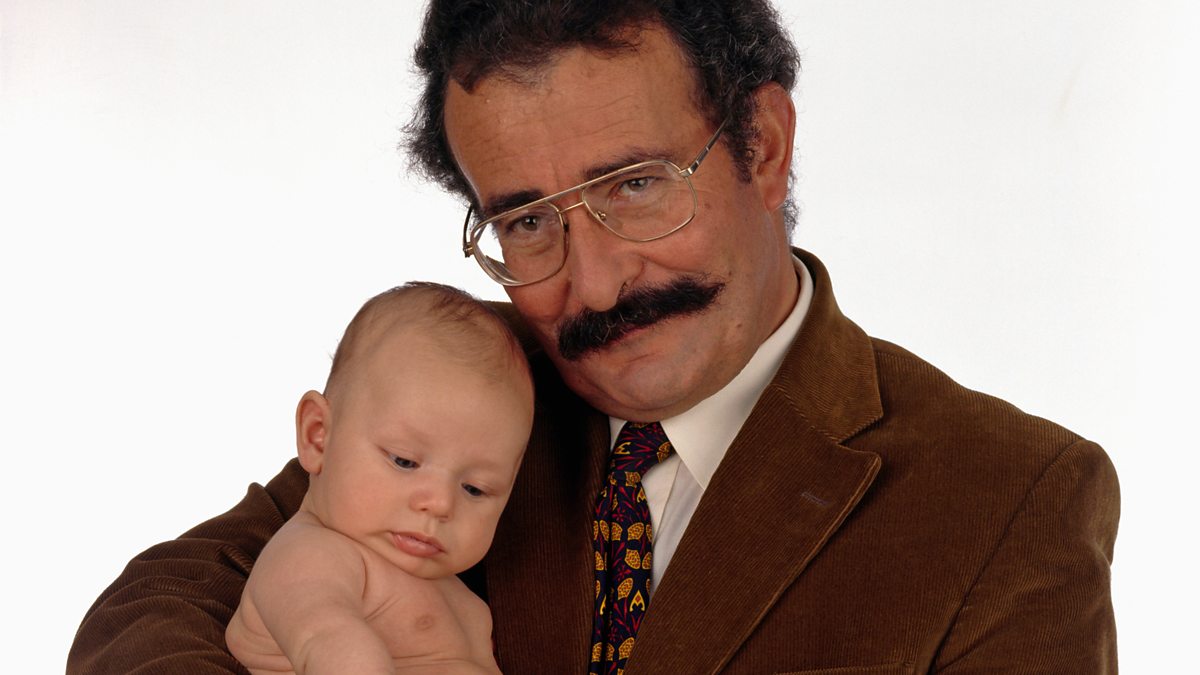
* En lire plus (en anglais): Qui est Lord Robert Winston
A inventé et conçu le tout premier Cathéter Wallace pour les transferts d'embryons difficiles.
En tant que Coordinateur Principal de la FIV (1993-1995) sous la direction de Robert Winston, Thanos Paraschos, avec Raul Margara et Karin Dawson, a été confronté à un défi important : Un certain nombre de transferts d’embryons étaient condamnés à l’échec en raison des irrégularités anatomiques des patientes (col de l'utérus courbé, faux passages, anomalies aiguës et rétroversions d'utérus, fibromes obstruant le canal cervical).
Pour surmonter ce problème, Thanos Paraschos a conçu le cathéter Wallace rigide utilisé depuis par des milliers de spécialistes de la fertilité et de cliniques de fertilité dans le monde. Le cathéter Wallace rigide a rendu possible le transfert d'embryons pour des millions de femmes présentant des irrégularités génitales, augmentant ainsi les taux de grossesse par FIV au niveau international. En 1995, le stylet Wallace a été utilisé pour la première fois à l'Hôpital de Hammersmith par Thanos Paraschos, qui supervisait à l'époque le programme de Fécondation In Vitro de l'hôpital en tant que Coordinateur Principal de la FIV sous la direction du Professeur Winston.
Présentation du Cathéter de Transfert d'Embryon assisté par Ultrason à l'Unité de FIV de l'Hôpital de Hammersmith
Dans le même temps, l'équipe chargée de la fertilité à l'Hôpital de Hammesrmith s'est rendue compte qu'elle avait besoin de voir le chemin suivi par le cathéter de transfert de l'embryon. Jusqu'alors, tous les transferts d'embryons étaient effectués à l'aveugle, sur la seule base de l'expérience du gynécologue. C'est alors que Thanos Paraschos a introduit le substitutif du cathéter assisté par ultrasons pour embryons.
Le cathéter de transfert d'embryons guidé par réflexion sonar est depuis utilisé par un nombre croissant d'embryologistes, ce qui contribue à augmenter les taux de grossesse dans le monde.
Expertise en matière de Traitements de la Fertilité
En tant que Coordinateur Principal de la FIV à l'Hôpital de Hammersmith, il a formé de nombreux gynécologues du Royaume-Uni et du monde entier à toutes les formes de procédures de FIV, telles que l'induction de l'ovulation pour la FIV IUI, le prélèvement des ovules, les transferts d'embryons, etc.
Collaboration avec le Lord Professeur R. Winston pour l'infertilité et la chirurgie tubaire
En collaboration avec le Professeur Winston, il a également pratiqué la chirurgie tubaire au moyen d'un microscope opératoire, la laparoscopie et les procédures de diagnostic par hystéroscopie pour l'infertilité et la chirurgie tubaire.
Impliqué dans le fonctionnement quotidien de la clinique de FIV de Hammersmith, il a réalisé plus d'un millier d'échographies vaginales et abdominales pour le suivi folliculaire et l'évaluation des grossesses précoces, ainsi que de nombreux tests postcoïtaux, et des procédures de diagnostic par hystérosalpingographie (HSG), de laparoscopie et d'hystéroscopie.
À l'Hôpital de Southmead, à Bristol, Thanos Paraschos a effectué de nombreuses interventions de chirurgie tubaire et de laparoscopie pour le prélèvement d'ovocytes, le transfert intrafallopien de gamètes (GIFT) et le transfert d'embryons. Toutes les techniques ci-dessus sont d'une grande valeur dans le diagnostic et la gestion des problèmes de début de grossesse, de pathologie ovarienne et de pathologie utérine.
En suivant des patientes en cours d'induction de l'ovulation, il a acquis une grande expérience de toutes les formes d'induction de l'ovulation et de superovulation, tout en effectuant plus d'un millier de prélèvements d'ovocytes par voie transvaginale.
Ses annonces et les études qu'il a publiées sur l'infertilité ont été utilisées par des milliers de médecins et de centres de fertilité dans le monde entier, contribuant ainsi à augmenter les taux de réussite de la FIV.
Consultation en ligne gratuite avec le Dr Thanos Paraschos et son équipe
Monsieur Robert Edwards et le Dr Thanos Paraschos, de respect mutuel pour l'Innovation en matière de FIV (premier cycle de FIV réussi au monde)
Thanos Paraschos décrit Monsieur Robert Edwards, l'homme qui a reçu le Prix Nobel de Médecine en 2010 pour sa contribution révolutionnaire à la FIV.
En plus d'être un scientifique brillant, et un esprit brillant, Bob Edwards est une personne vraiment modeste, qui attendait la reconnaissance qui lui est due depuis longtemps.
Le Dr Paraschos souligne également la contribution de Bob Edwards à la médecine régénérative et aux thérapies géniques. Grâce à ses recherches pionnières, Bob Edwards a envisagé la régénération des parties détruites du corps humain. Les Spécialistes de l'Infertilité, l'Embryologiste Robert Edwards et le Gynécologue Patrick Steptoe, ont été les premiers à réussir un cycle complet de FIV, en extrayant un ovule, en le fécondant avec du sperme et en réimplantant l’embryon obtenu dans la mère.
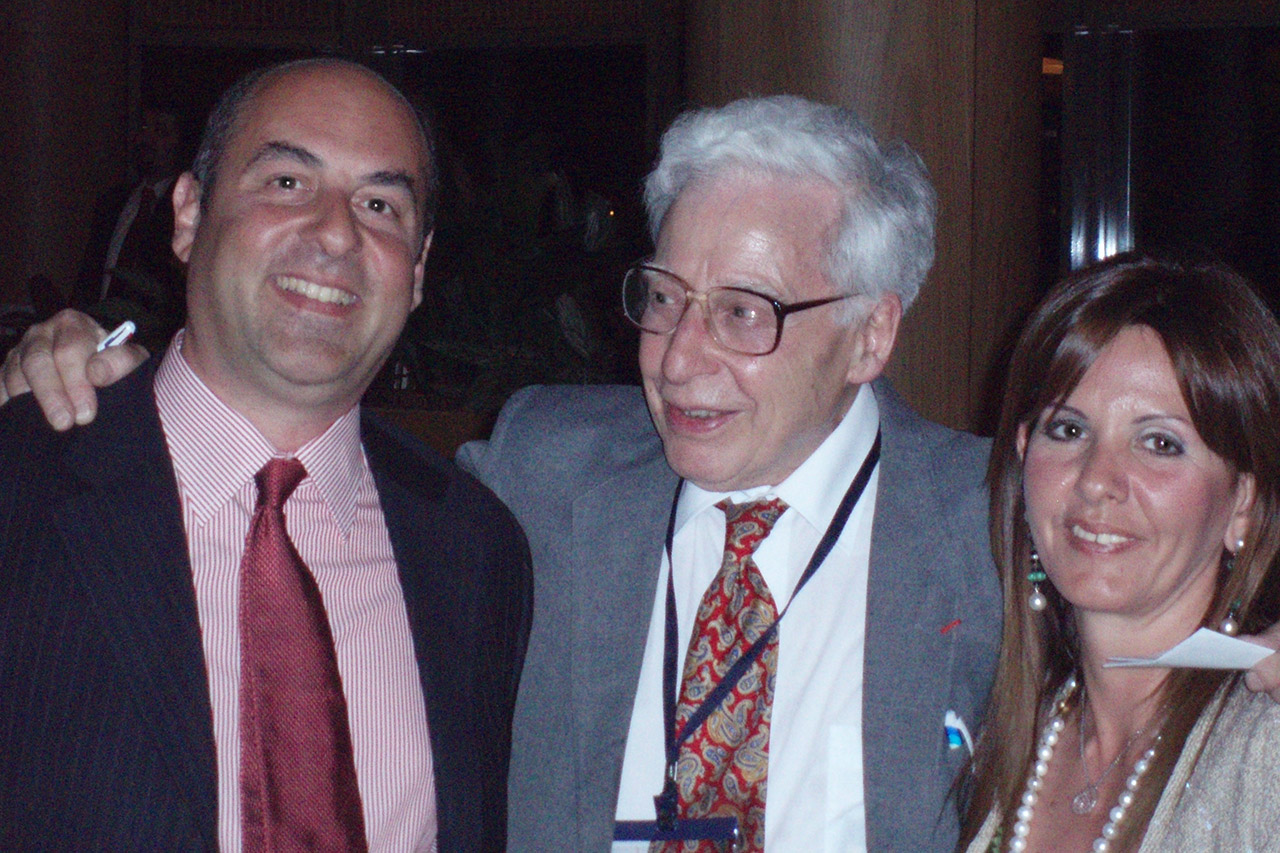
On estime à plus d'un million le nombre de personnes qui ont été conçues par FIV, et environ 9 000 bébés naissent chaque année grâce à cette procédure dans ce pays.
* En lire plus (en anglais): Monsieur Robert Edwards, le pionnier de la FIV
- Formation en Médecine
- Spécialiste de la Fertilité
- > Formé auprès du Lord Professeur Robert Winston
- > Monsieur R. Edwards (le Pionnier de la FIV) et Thanos Paraschos
- Obstétricien
- > Collaboration avec le Professeur Kypros Nicolaides
- Gynécologue
- Publications in Reer-Reviewed Journals (in english)
- Presentations in Infertility & Reproduction (in english)
Obstétricien formé pour les Grossesses à Haut Risque et les Complications à la Naissance.
En tant qu'Obstétricien et Spécialiste de la Fertilité, le Dr Thanos Paraschos a aidé plus de 30 000 bébés à naître. Depuis 1996, il dirige le centre médical EmBIO (Athènes, Grèce) et effectue tous les types d'accouchement à la Clinique de Maternité IASO.
En tant que Chef De Clinique à l'Hôpital de Southmead (Bristol), la troisième plus grande clinique d'obstétrique en Angleterre, il était responsable de tous les accouchements opératoires (forceps de Simpson, Wrigley et Kielland, ventouse et Césariennes). Il était notamment chargé de former les nouveaux obstétriciens et sages-femmes.
Avec Mme G. Turner, il réalise des grossesses compliquées (diabète, phéochromocytome, prolactinome, hémoglobinopathies, lupus et allo-immunisation rhésus, maladie rénale). À l'époque, le Dr Paraschos dirigeait la clinique prénatale pour diabétiques avec l'équipe médicale et assistait aux réunions sur la morbidité et la mortalité périnatales.
À l'Hôpital de Southmead, le Dr Paraschos a acquis une solide expérience dans la gestion de l'accouchement normal et anormal. L'unité effectue 6250 accouchements par an. En tant qu'Agent Principal de L'établissement à l'Hôpital de Southmead, il a effectué de nombreuses extractions ventouses, des accouchements par traction et par forceps rotatifs. Il a également effectué des accouchements par le siège et des accouchements de jumeaux par voie vaginale. Des césariennes électives, ainsi qu'urgentes ont été effectuées pour diverses indications cliniques.
En tant que Chef De Clinique à l'Hôpital Universitaire de Hammersmith (Londres), il a acquis une expérience significative dans la gestion des grossesses à haut risque. L'Hôpital de Hammersmith est l'hôpital par excellence pour les grossesses à haut risque à Londres. L'hôpital accepte jusqu'à 200 cas de transfert in utero par an, en provenance de tout Londres et des districts environnants. Pendant deux ans (1993-1995), le Dr Thanos Paraschos s'est occupé de cas de prééclampsie grave, de retard de croissance intra-utérine, d'accouchement prématuré, de rupture prématurée des membranes et de grossesses multiples (jumeaux, triplés), d'accouchement chez les femmes de plus de 45 ans, de femmes enceintes diabétiques, etc.
En tant qu'Agent Principal de l'Établissement à l'Hôpital Universitaire de Norfolk et Norwich (NNUH), le Dr Thanos Paraschos a acquis une grande expertise dans la gestion des problèmes obstétriques et des complications pendant la grossesse. Le taux d'accouchement au NNUH, l'un des plus grands hôpitaux du Royaume-Uni, est de 5500 par an. En effectuant un large éventail de procédures à risque obstétrical, il a acquis une expérience précieuse.
Échographie de Grossesse
Le Dr Paraschos a acquis ses compétences en échographie au King's College Hospital sous la direction du Professeur Kypros Nikolaides, l'inventeur du test de translucidité nucale (nuchal scan). En travaillant avec M. P Smith à l'Hôpital de Maternité de Bristol (Southmead), il a acquis de l'expérience dans l'échographie détaillée et les études Doppler, et a amélioré son expertise dans les procédures d'échographie obstétrique, en effectuant des amniocentèses par ultrasons et des prélèvements de villosités choriales. (CVS).
Collaboration avec le Professeur Kypros Nikolaides
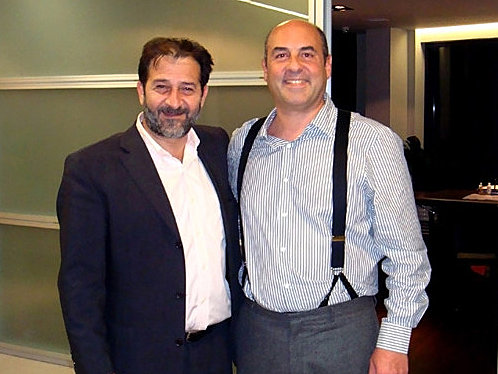
* Le Professeur Nikolaides avec le Dr. Paraschos à Embio
Le Centre Médical EmBIO collabore avec le Professeur Kypros Nikolaides, Professeur de Médecine Fœtale au King's College de Londres. Leur collaboration scientifique donne la possibilité aux étudiants de médecine du King's College de Londres spécialisés dans les Technologies de Reproduction Assistée de suivre l'équipe de fertilité du Dr Paraschos à EmBIO tout au long des procédures de FIV avancées et régulières.
À propos du Professeur Kypros Nikolaides
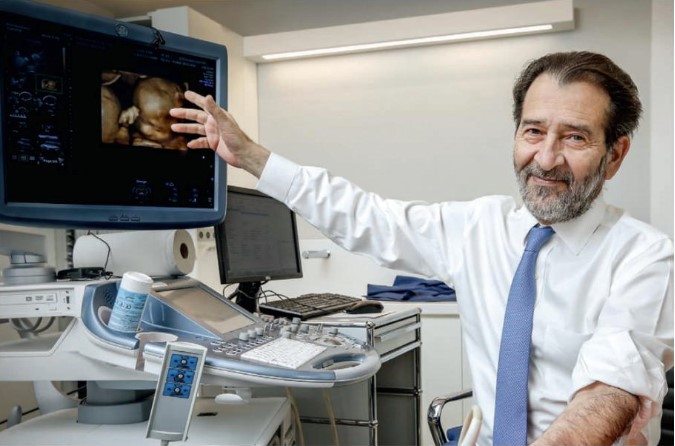
Kypros Nikolaides est professeur de Médecine Fœtale au King's College de Londres. Né à Paphos en 1953, il a débuté sa carrière en 1980 après avoir obtenu son diplôme du College of Medicine and Dentistry du King's College de Londres, où il a rejoint les Professeurs Stuart Campbell et Charles Rodek pour mener des recherches au Département d'Obstétrique et de Gynécologie en tant que premier assistant du Professeur Rodek.
En 1986, Nicolaides est devenu Directeur du Centre de Recherche en Médecine Fœtale de Harris Birthright, la première Unité de Médecine Fœtale du Royaume-Uni, ouverte en 1984 par Diana, Princesse du Pays de Galles. Son programme de recherche et d'enseignement a fait du King's College Hospital le centre de médecine fœtale le plus important et le plus renommé au monde.
Nicolaides est l'auteur de plus de 1 500 articles de journaux évalués par des pairs et de plus de 30 livres et monographies. Il a un indice H de 185, ce qui est le plus élevé de tous les Obstétriciens & Gynécologues du monde, et ses recherches ont été citées plus de 130 000 fois. Il a supervisé 55 médecins pour l'obtention de leur Doctorat et Diplôme de Médecine et a fourni une formation en Médecine Fœtale à plus de 700 médecins provenant de 50 pays.
* En lire plus (en anglais): Professeur Kypros Nikolaides
USIN - Soins Pédiatriques
Travaillant à la SCBU de l'Hôpital de Southmead, le Dr Paraschos a participé à tous les aspects des soins néonatals. L'Hôpital de Southmead prend en charge les 6 250 enfants nés à l'hôpital. Dans l'unité spécialisée de soins intensifs néonatals (USIN), il a acquis une précieuse expertise dans les procédures de soins néonatals telles que : la ponction lombaire, l'insertion de la ligne ombilicale et de la ligne périphérique, la réanimation des nourrissons, l'intubation endotrachéale et la ventilation endotrachéale. Il était le premier à être appelé pour les accouchements chirurgicaux ou lorsqu'il y avait des signes de détresse fœtale.
Consultation en ligne gratuite avec le Dr Thanos Paraschos et son équipe
Lire plus :
- Formation en Médecine
- Spécialiste de la Fertilité
- > Formé auprès du Lord Professeur Robert Winston
- > Monsieur R. Edwards (le Pionnier de la FIV) et Thanos Paraschos
- Obstétricien
- > Collaboration avec le Professeur Kypros Nicolaides
- Gynécologue
- Publications in Reer-Reviewed Journals (in english)
- Presentations in Infertility & Reproduction (in english)
Gynécologue
Être gynécologue, c'est aider une femme à être en bonne santé et fertile. Fonder une clinique de fertilité et de gynécologie était ce que Thanos Paraschos a toujours voulu faire.
Enseignant et pratiquant dans les principales cliniques de gynécologie du Royaume-Uni, il s’est rendu compte à quel point l'expérience chirurgicale d'un gynécologue peut être cruciale pour une patiente. Il ne s'agit pas seulement de la différence entre une longue incision en chirurgie ouverte et une minuscule incision par laparoscopie pour une myomectomie.
Le plus important, c'est la confiance. Et cela est acquis grâce à une vaste expérience dans :
- les Tests de Gynécologie (échographie, hystéroscopie, hystérosalpingographie - HSG, colposcopie, biopsie de l'endomètre) et diagnostic grâce auxquels la meilleure thérapie, chirurgicale ou non, peut être fournie.
- la Chirurgie Gynécologique : hystérectomie totale abdominale, hystérectomie totale vaginale, myomectomies, colposuspensions, ablation endométriale au laser, résection endométriale, réparation antérieure, réparation postérieure, laparotomie pour grossesses extra-utérines et accidents de kystes ovariens) etc.
Chirurgie Gynécologique à EmBIO et IASO
Depuis 1996, le Dr Paraschos pratique des chirurgies gynécologiques laparoscopiques avancées à l'Hôpital d'EmBIO et IASO.
L'essentiel de son expérience en tant que chirurgien gynécologue est le suivant : Si une opération peut être évitée, elle le sera, pour autant que ce soit à votre avantage. Il est parfois nécessaire de faire confiance à votre gynécologue lorsqu'il vous dit : "Assez d'échographie, il est temps de faire une hystéroscopie".
Urgences Gynécologiques
À l'Hôpital de Southmead et à l'Hôpital Universitaire de Norfolk et Norwich, respectivement les 3e et 6e plus grandes cliniques obstétriques du Royaume-Uni, il a appris à diagnostiquer et à traiter chirurgicalement les urgences gynécologiques.
Oncologie Gynécologique
À la Clinique de Colposcopie du NNUH, le Dr Paraschos a appris à diagnostiquer et à traiter les néoplasies cervicales intraépithéliales : excision au laser et excision à l'anse de la zone de transformation, et ablation au laser pour les CIN. À l'Hôpital de Southmead, j'ai pratiqué la chirurgie radicale en oncologie gynécologique.
Urogynécologie
À l'Hôpital de Southmead, il a effectué des colposuspensions et des procédures Marshall-Marchetti-Krantz (MMK) et Stamey, avec Paul Abrams, urogynécologue de renommée internationale dans le domaine de l'incontinence urinaire.
Endocrinologie
À l'Hôpital de Southmead, il s'est occupé de la gestion des problèmes des femmes ménopausées. À la Clinique d'Endocrinologie, avec le Professeur S. Franks, il a pris en charge des problèmes tels que l'hyperprolactinémie, l'hirsuitisme et la tension prémenstruelle.
Consultation en ligne gratuite avec le Dr Thanos Paraschos et son équipe
- Formation en Médecine
- Spécialiste de la Fertilité
- > Formé auprès du Lord Professeur Robert Winston
- > Monsieur R. Edwards (le Pionnier de la FIV) et Thanos Paraschos
- Obstétricien
- > Collaboration avec le Professeur Kypros Nicolaides
- Gynécologue
- Publications in Reer-Reviewed Journals (in english)
- Presentations in Infertility & Reproduction (in english)