Egg Donation in Greece
Athens, Greece: a popular destination for egg donation abroad
Greece today is a top destination for those looking for IVF treatments with egg donation abroad. The main reasons are the high standards of the Greek IVF clinics , the innovative treatments with impressive success rates, as well as the lower cost of medical care compared to most European countries or America. Greece: IVF and egg donation services are widely recognized for combining medical excellence with affordability, attracting hopeful parents from around the world.
Egg donation in Greece
Egg donation in Greece is a safe procedure for donors and recipient couples or single women.
Anonymity is a strict requirement in Greece and is strongly reinforced. General information about the donor's traits is available, but her identity is never disclosed. You will remain anonymous to the donor as well.
Greece: IVF and egg donation services are backed by progressive legislation and medical excellence. Greece has a particularly high age limit for IVF : the law of 2022 allows a woman to be up to 54 years old. This is the highest age limit for IVF in Europe.
At EmBIO IVF Center in Athens, we are especially proud of:
- our zero waiting time policy
- the 30,000 babies born by IVF treatments since 1996
- our exceptional and highly trained fertility team
- our reasonable prices that make egg donation an affordable treatment for anyone who needs it
Almost all countries in the world have direct flights to Athens . Flights, especially from Europe, last between 2-4 hours, making the journey quite simple and easy .
A lengthy stay in Greece is not necessary for your treatment, and in the 2-5 days you will spend in Athens, you can get to know its ancient treasures, as well as its modern beauties, enjoy the sun and the sea on its beaches, or travel to one of the nearby lovely Aegean islands.
Additionally, unlike other countries, Greece offers female couples the possibility to use IVF treatment legally, as long as one of the 2 women signs a notarized document that she will undergo IVF treatment with a sperm donor.
All the above reasons make EmBIO in Athens an ideal choice for IVF with egg donation abroad .
Free Online Consultation with Dr Thanos Paraschos and his team
What is the advantage of using donor eggs?
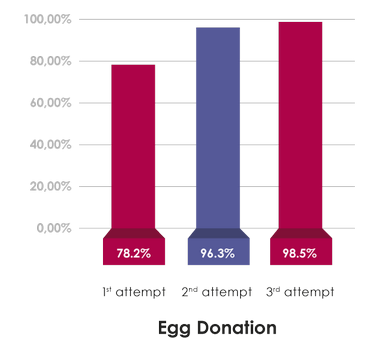
- IVF with egg donation at EmBIO has the highest success rate , reaching 78% on the first attempt. The main reason is that eggs (oocytes) come from healthy, young donors.
- It also allows for strong biological and/or developmental relationships within a family because donor eggs are fertilized with the male partner's sperm, matured to an early embryonic stage, and then placed in the female partner's uterus, providing her with the same gestational experience as natural conception.
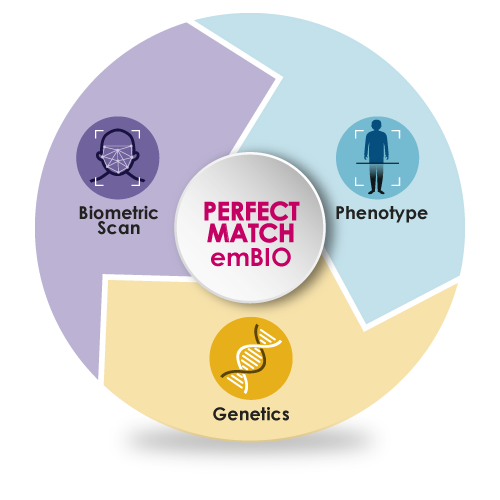
Perfect Match EmBIO
For patients who choose egg or sperm donation as part of their assisted reproductive treatment and want their child to resemble them or have specific characteristics such as height, eye, hair color, etc., our fertility center offers you the "Perfect Match Embryo".
What is IVF with donor eggs?
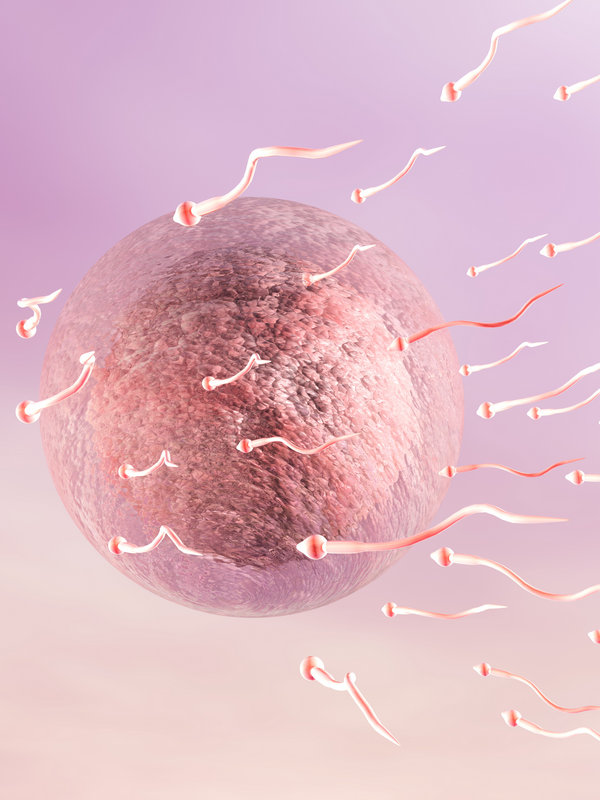
Today there are thousands of women who, for many different reasons, need donor eggs in order to conceive. IVF with egg donation is an anonymous procedure in which the donor provides oocytes to the receiving couple.
Donor eggs from a volunteer are fertilized with sperm from the recipient's partner. After fertilization, the resulting embryos are transferred to the receiving woman.
Over one million children are estimated to be born worldwide as a result of egg donation each year, with 3,000 babies born in the United States and 1,500 in England.
Why choose EmBIO IVF Center?
EmBIO welcomes patients from many different countries worldwide, offering trusted Greece: IVF and Egg Donation Services. Founded in 1996, EmBIO has gained recognition for its high success rates in IVF treatments, state-of-the-art technological equipment, and an experienced fertility team led by the internationally renowned Dr. Thanos Paraschos, who trained alongside the pioneers of IVF treatment .
We also emphasize holistic care tailored to the needs of each woman, man, or couple. Those who cross the threshold of EmBIO will immediately feel our commitment to creating a supportive relationship and becoming fellow travelers on their journey to building a family.

IVF in Greece with egg donation is an option for:
A) Women who can't produce the essential eggs for conception:
- Premature ovarian failure : Women born without or with under-developed ovaries. (eg, Turner's Syndrome)
- Women suffering from premature menopause : Most women go through menopause in their mid-to-late 40s or early 50s.
After menopause, a woman is no longer capable of conceiving because her ovaries stop producing eggs and sex hormones.
However, some women may experience this considerably earlier, perhaps even in their teens or early 20s, before they would have even given any thought to starting a family.
This condition is called premature ovarian failure or premature menopause. - Ovarian damage following surgery, radiation or chemotherapy
B) Women with active ovaries who need egg donation because:
- carry an inheritable genetic disorder such as Duchenne Muscular Dystrophy or haemophilia. These diseases can be passed on to their offspring. Rather than risk giving birth to a child who might suffer greatly and die at an early age, some women choose to have a chance of an unaffected child by egg donation.
- they repeatedly fail to respond to ovarian stimulation in an IVF program. Some women persistently produce poor-quality eggs or embryos when stimulated. These ladies may improve their overall pregnancy chances with egg donation.
- their own eggs repeatedly fail to fertilize in an IVF program, or their own embryos repeatedly fail to implant
- they have a history of recurrent miscarriage
How can I be certain that the donor eggs are of good quality?
EmBIO follows strict procedures that guarantee the quality of all assisted reproduction treatments. To become a female egg donor at the EmBIO egg bank , a woman must meet all of the following requirements:
- Be between the ages of 19 and 35.
- Have no personal or family history of genetic diseases.
- Have a body mass index of less than 32.
- Have an FSH level of less than 8.
- Have both ovaries.
Pursuant to Greek law, egg donors and sperm donors must undergo a strict examination for infectious diseases.
At EmBIO, we go further by carrying out additional checks to ensure your safety: all donors are thoroughly examined by a gynecologist and tested for chlamydia, cytomegalovirus, cystic fibrosis, hepatitis B and C, AIDS, karyotype, syphilis, and anemia.
Start your treatment in Athens without a waiting list
For women who need donor eggs, we have ensured that there is practically no waiting time in finding a suitable donor.
We run a range of donor egg programs designed to meet the needs of infertile couples, following the recommendations of effective legislation. In any case, we are working to provide recipients with a matched donor through the highest medical care and treatment standards.
Notably, unlike other programs, we do not advertise, recruit, or solicit egg donors. All donors in our program have located us as a result of their own diligence and research. You, therefore, can be assured that these women are mature, thoughtful, and have considered all the ramifications involved.
EmBIO IVF Center has a team of highly trained experts dedicated to assisting couples who are considering the use of donor eggs. They will work with the couple and explain what to expect during a donor egg cycle, how to select an egg donor, and how donors are screened.
Free Online Consultation with Dr. Thanos Paraschos and his team
What is the procedure?
The couple or the woman who will undergo IVF with an egg donation treatment must choose the characteristics of the donor she wants. The EmBIO Fertility Team will coordinate donor and recipient cycles to achieve fresh embryo transfer (whenever possible) and maximize IVF success rates.
The synchronization of the cycles involves the use of medication to create a welcoming environment in the recipient's endometrium which will facilitate the implantation of the embryos.
All mature eggs produced in a single cycle are fertilized with the sperm of the partner/spouse or sperm donor (if needed). Embryo freezing is strongly recommended if there are excess embryos after embryo transfer. Cryopreserved embryos can be used in subsequent IVF attempts, whether the result of the previous embryo transfer is successful or not.
The procedure in detail:
- Contact a gynecologist who specializes in infertility treatments: Before joining an egg donation program, a thorough medical history should be recorded and very specific gynecological examinations should be performed.
- Meeting with the program coordinator : The meeting involves filling out a particular form in which the couple lists the characteristics they would like the egg donor to have.
- Counselling : If desired, with the help of a professional, the couple can discuss any potential social or psychological issues that may arise from such a process. Future parents also have the opportunity to communicate their ideas and feelings regarding the matter and learn about the needs and rights of the child who will be born using donor eggs.
- Blood test : The blood tests performed depend on the IVF protocol each couple is following. All programs routinely test the couple for measles, AIDS, hepatitis C, and B.
- Sperm analysis : The test requires a two to three-day abstinence.
- Uterine ultrasound examination and, if necessary, hysteroscopy or hysterosalpingography.
- Administration of medication .
- Completion of the necessary consent document .
- Schedule appointments : The doctor in charge will schedule your appointments in compliance with the specifications you intend to follow.
- Donor selection : All egg donors at EmBIO are under 35 years old. The doctor in charge will consider all the characteristics you are seeking in a donor and proceed to select the one who most closely matches your requirements. You will be informed about the characteristics of the selected donor, and after acquiring your approval, the treatment will begin.
- Treatment principle : Includes the preparation of the uterus to accept the embryos selected for embryo transfer.
- Fertilization : This process involves the fertilization of the donor's eggs with the sperm of the spouse or donor. After fertilization, you will be informed about the number of embryos that have developed.
- ICSI Microfertilization : It is a technique frequently employed when donor eggs are used. This is something that will be discussed and decided upon after the partner's sperm analysis.
- Genetic testing for PGD : Following selection, the fertilized eggs are rigorously examined to look for chromosomal and DNA issues as well as the presence of inherited diseases.
- Embryo transfer : Once you are notified of the number and quality of the embryos, your doctor and embryologists will suggest the number of embryos that need to be transferred to the uterus. It is important that both partners are present in this process. In the case of blastocyst transfer, a maximum of two are transferred. The embryos are placed in the uterus in a span of 15 minutes. You will be able to leave the clinic and return to your regular activities one hour later. After 12 days, a blood test will be performed to detect pregnancy.
Common Questions for Greece: IVF and Egg Donation Services
How many licensed IVF clinics are there in Greece?
In October 2022 there were 50 licensed fertility units and cryopreservation banks in Greece. You will find EmBIO at No 10 on the list .
Is egg donation anonymous?
Yes, in accordance with current legislation, only anonymous egg donation treatments are allowed in Greece.
Is there an age limit for IVF in Greece?
Since the summer of 2022, the age limit is 54 years old. It is the highest age limit for IVF treatments abroad.
Can I choose the traits of the donor to match my own?
You will select the donor's fundamental attributes (hair, eye, skin, height, etc.), and we will make sure to match you with the most appropriate donor. Read more about choosing an egg donor .
How much does an IVF with an egg donor cost?
At EmBIO, every effort is made to keep the cost of each fertility therapy as reasonable as is humanly possible. Check the cost of egg donation and all other assisted reproduction treatments.
Can IVF be performed with embryo adoption or a surrogate mother?
Yes, embryo donation or embryo adoption is an option for couples or single women who require both donor sperm and eggs.
In vitro fertilization with a surrogate mother is also possible, ie when another woman undertakes to conceive the fetus of a couple and carry their child to term.
Is it possible to use a sperm donor too?
Yes, the combination of donor eggs with donor sperm is possible in our clinic and offers the possibility of procreation to couples where a man and a woman both have an infertility problem.

Read experiences of women who became pregnant with a donor egg